


A few weeks ago, I discussed the differences between medical doctors (MDs) and academic doctors (PhDs)—please read “The Unexpected Burden of Being Not-a-Medical-Doctor” for more background. However, today I propose exactly how scientists can integrate into the U.S. medical system to alleviate physician burnout, provide comprehensive patient care, and reduce the chronic illness epidemic.
After being denied appropriate care to diagnose the root cause of my symptoms, I used my skills as an academic to complete a deep literature review based on my lab results and symptoms. I’ll admit this process took many hours and multiple epiphanies before I began making connections between my symptoms, causes, and their possible remedies.
For example, I was diagnosed with NSAID-hypersensitivity in childhood. In my research, I discovered NSAIDs and salicylates both bind to the same enzyme, cyclooxygenase-1 (COX-1). In terms of medications, this connection is fully captured under the diagnosis of “NSAID-hypersensitivity.” However, salicylates are also found in mint flavoring, fragrances, and cosmetics. Continued inhibition of COX-1 with this disorder can cause several symptoms I was facing: respiratory distress, angioedema, and anaphylaxis.
How did I adjust to this knowledge?
I purchased fragrance-free cosmetics and mint-free toothpaste… suddenly my sore throat of two years was gone overnight, and my asthma was better managed. A very simple life change—new shampoo and lotion—improved my quality of life rapidly. I was shocked my physicians never mentioned this possible solution to me. Potentially they didn’t know, or perhaps did not have the time to explain it to me. As a scientist integrated into a physician team, I would try to communicate these possible connections and lifestyle changes to comprehensively care for our patients.
To investigate this potential relationship between physicians and scientists, I outlined a sample schedule for a treating physician at an outpatient clinic (Figure 1).
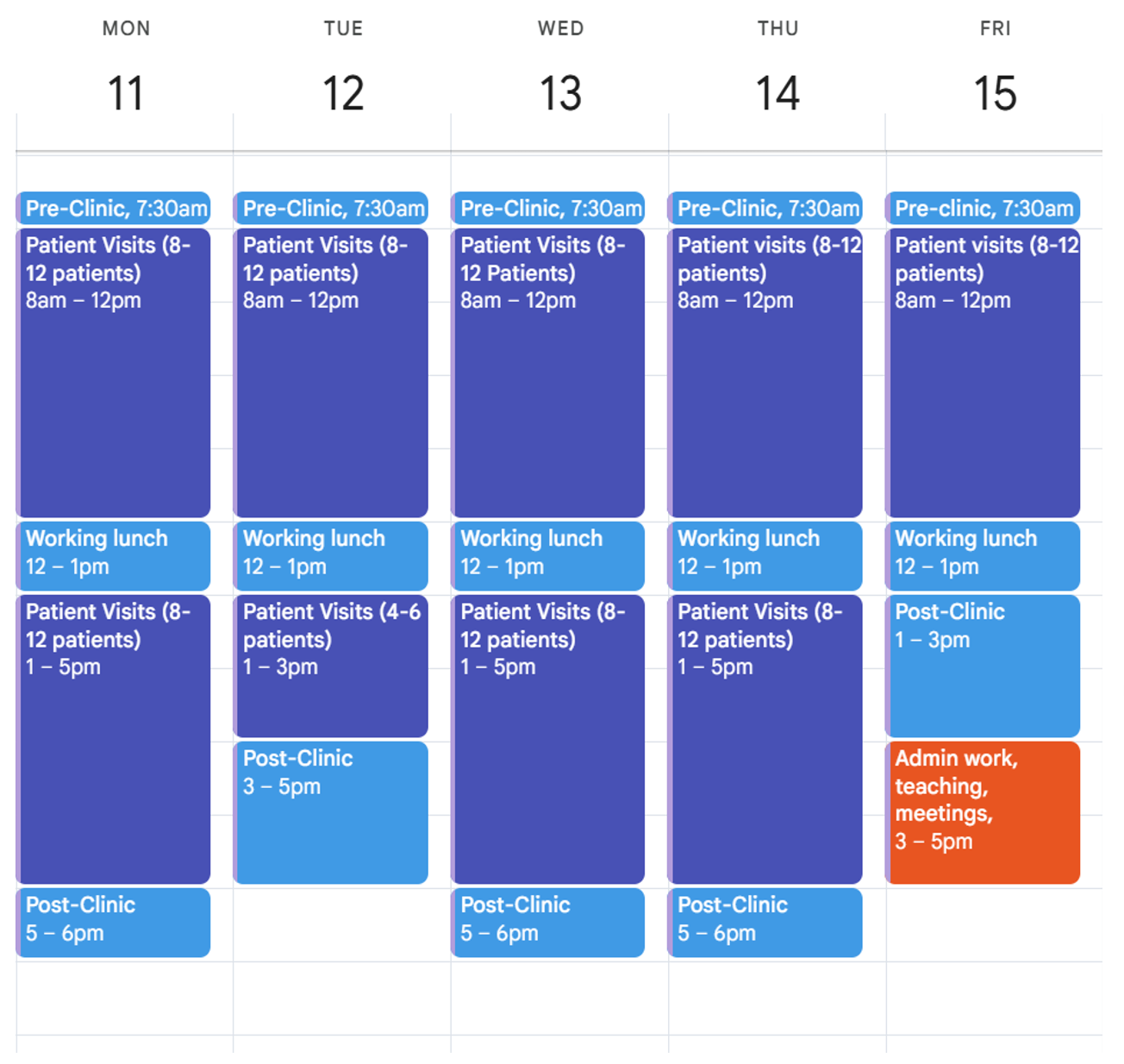
In Figure 1, we see a physician working a standard 8am–5pm outpatient shift would spend ~32 hrs/wk interfacing with patients and ~7 hrs/wk catching up on charts (plus a working lunch), leaving them with a mere ~2 hrs/wk for administrative work, teaching, or attending internal meetings. In total, this schedule allows for 16-24 patients/day (a total of >70 patients/wk).
In this scenario, physicians have very little time to prepare for, or follow up on, patient visits. For healthy patients, this system works well, but for complex patients, it’s a nightmare. A study by Tai-Seale et al., reported patients spoke to their physicians for an average of 15.7 minutes, with each topic covered in the meeting totaling only 1.1 minutes, leading to insufficient time for patients with complex or multiple problems.2
There is simply no time for physicians to spend the necessary time picking their way through a complex history, reviewing literature, and reading about emerging diagnostic criteria. Enter the PhD Scientist Consultant.
To address the gaps physicians face daily due to increased patient contact pressure, a PhD scientist consultant can be added to a team. In this case, the PhD scientist consultant would never directly interface with patients, freeing up 80% of their day compared to their physician colleagues. Though PhD scientists have not attended medical school, they possess all the necessary skills to evaluate patient histories, review diagnostic criteria and literature, synthesize hypotheses, and communicate complex data into meaningful action.
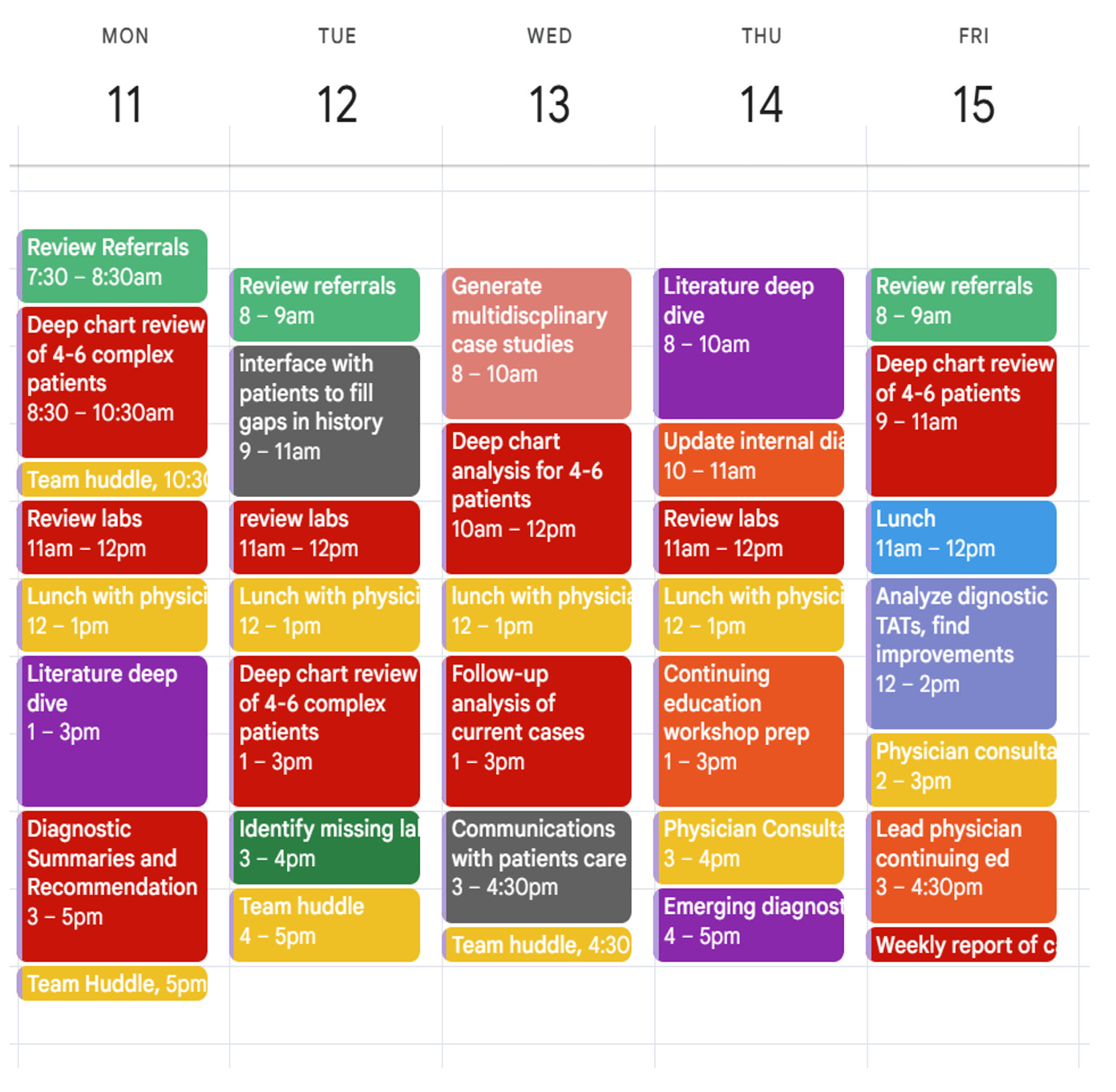
In Figure 2, I generated an example weekly schedule for a PhD scientist consultant. Far more heterogeneous, the scientist consultant would have ample time (~22 hrs/wk) to review complex patient referrals, analyze existing charts and labs, communicate with internal care teams, and generate diagnostic summaries/recommendations. They could also spend ~6 hrs/wk analyzing literature and understanding emerging diagnostic criteria, ultimately generating internal protocol updates and referral strategies. As a team member, they are available ~8 hrs/wk to interface or brainstorm with physicians on complicated cases. And finally, they can dedicate ~4 hrs/wk to generating and leading a continuing education meeting or newsletter with physicians.
In this scenario, the addition of a scientist consultant allows physicians to continue their ~32-hour, patient-facing schedule, without the added stress of following up on complex patients. The PhD scientist consultant can then spend as much time as required to analyze the patient’s history, review their charts, and request the physician follow up with the patient to order tests, medications, or gather more information on the patient’s medical history. The PhD scientist and the treating physician are a collaborative team, treating the same patient, sharing the workload, improving patient experiences, and reducing physician burnout.
By simply looking at these two schedules, it becomes clear physicians do not have the time or energy to dedicate to carefully analyzing, researching, and suggesting possible out-of-the-box solutions (such as going fragrance-free) to their >70 patients per week.
It also becomes apparent we already have the solution to their shortcomings: an entire cohort of academics who are experts in reading complex literature, synthesizing ideas, and educating others—the PhD scientists. People who are doctors, just not patient-facing ones.

That’s a good read. Thanks for sharing. 👍
I love this idea and recently wrote about this general tragedy that physicians systematically don’t have enough time for science. But I’d love to figure out a world in which we have a scalable and economically viable path to allow scientists to work more translationally in the way you suggest?