

Are we the masters of our fate?
Do I really have control over the things I do? This is a question I often ask myself as I procrastinate yet another important task. There are many things I enjoy doing, yet I often find myself spending time doing things I don’t want to. Is this the consequence of my own actions? Or can I blame this on fate, a creator, or a series of domino effects—something over which I have no control?
Free will is a concept that has caused much debate. Are our existences simply a collection of inevitable events? Or do we truly have the ability to make choices that impact the course of our lives?
I argue there is room for free will, and this knowledge can be used responsibly to live with purpose. I would like to share how I came to this belief through a conversation about quantum computing.
The arguments against free will
Years ago, I was taking a bioethics class when the topic of bodily autonomy came up. We were discussing the topic of medical decisions and when the patient can no longer decide for themselves. One student argued the patient has free will and should be able to decide whatever they want. The professor then led a discussion on how this fits into the different ethical frameworks we had discussed throughout the class. Before moving on to the next topic, they quipped , “By the way, I don’t necessarily believe in free will.”
This stopped me, and I missed when they mentioned the content of the next test. What did they mean “free will” doesn’t exist? Am I not the master of my own choices? I wanted to look more into the arguments against this.
I came across the work of Dr. Robert Saplosky, a neuroscientist at Stanford. He generally argues biology and determinism do not leave room for our neurons to act independently. Broadly, determinism is the philosophical framework that all happenings are caused by the many happenings that came before it, and they cannot be separated from each other. Everything in life is a domino affected by the series of dominoes that fell before it. Saplosky argues this also applies to the biological processes which govern our actions. Since biology is a combination of determined actions, Saplosky believes there is no room for free will.
This began to make sense to me. I am an engineer after all. By practice, I try to understand all the components of a system so I can control them myself. My actions may similarly be part of a larger system. As a tissue engineer, I often experience results in my research that just don’t make sense to me. I know this usually means there is some other phenomenon that has not been accounted for before. However, my first thought is these results must be random.
Does randomness exist?
If randomness exists, would this mean the determinist framework against free will falls apart? Can the domino fall by itself? I set out to find examples of true randomness to support the possibility of free will.
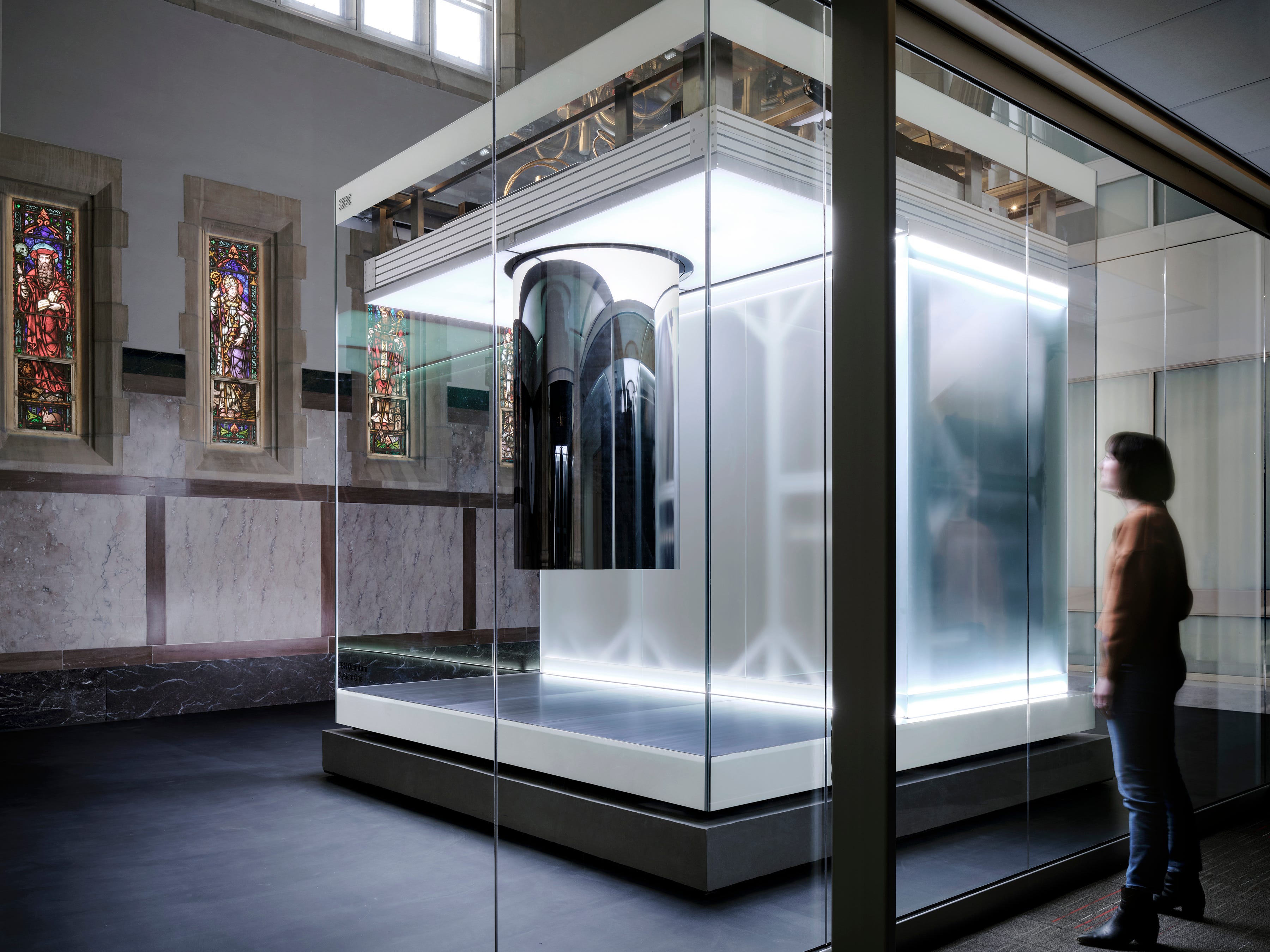
Recently, I was discussing some of the advances in quantum computing. Classical computers utilize traditional “bits” that represent a value of 0 or 1. The functional unit of a quantum computer is called a qubit. These qubits indicate the spin states of electrons which can be up or down, effectively encompassing the same 0 or 1 as classical bits. Electrons, however, can behave in a superimposed manner between these two spin states, meaning a qubit may effectively display a value of 0, 1, somewhere in between, or both.
A researcher in quantum computing at Rensselaer Polytechnic Institute mentioned the headaches this behavior causes. They conveyed these qubits are difficult to work with since the behavior is fundamentally random. You can run an experiment several times, and the best you can do is model the probability in which the electron may behave.
Are electrons random enough?
Is this the example I’ve been looking for? The difficult-to-predict nature of electrons has been at the center of theoretical physics for the past century. The works of Heisenberg and Schrodinger indicate, at best, we can only predict the nature of electrons. Once we try to directly measure their behavior, the probabilities we generate begin to fall apart. These theories indicate the nature of electrons is effectively random.
The field of physics does not directly agree with this interpretation. Most quantum physicists would argue the behavior of electrons is still governed by physical laws. We either do not understand all the physics yet, or we are dealing with a system with so many variables that trying to model probability is more pragmatic. There even exists a theory referred to as “super determinism,” which encompasses the probabilistic nature of quantum mechanics to support a determinist framework.
Regardless, electrons effectively appear to act in a random nature. Trying to rationalize the behavior of electrons, random or not, still requires one thing: a sort of faith. We fundamentally do not yet understand exactly how electrons behave, so experts in the field seemingly choose to believe whether or not this behavior is truly random.
What do I even do with this information?
With all this information on the philosophy of free will, quantum computing, and electron behavior, I find myself at the same place I started: confused. I’m still not sure if randomness or free will exist. Are the fundamental forces of nature random, and how does that influence my “choice” to eat 15 hot dogs whenever I please?
Despite the argument that randomness supports the existence of free will, the idea of living in a random world didn’t bring me comfort. I do believe my actions have meaning and influence the people around me. However, I do not believe I can enact change in my surroundings without a decided effort to do so.
For the time being, I’m trying to adopt a style of life somewhere in between. I want to live with purpose, not randomly. I will not just make random decisions to prove I have free will, and I will avoid letting the influences necessitate the way I respond. In the past year, I have made a few positive changes to my lifestyle because of this. It required discipline and re-shaping of my mindset several times over, but it proved to me I have the power to choose the way I want to live.
