
Trademark dispute enters the court of public opinion
We kicked off 2026 with a significant trademark infringement lawsuit between outdoor apparel brand Patagonia and environmental activist and drag queen Pattie Gonia (Wyn Wiley). While trademark attorneys have kept tabs on this lawsuit over the last six months, Gonia recently made the unilateral decision to thrust it into the mainstream via a tactful public relations maneuver posted just days before the start of Pride Month.
On Wednesday, May 27, Pattie posted the following statements to their Instagram: see here.
Pattie also published the following open letter on their website: see here.
I implore readers to examine Pattie’s statements in full before continuing to read this article. Bonus points for reading the complaint filed by Patagonia, too: see here.
With these statements, Pattie is attempting to use public pressure to get Patagonia to drop the lawsuit against them. Pattie’s accuses the company of using trademark law in a targeted attempt to silence their environmental activism and oppose the drag queen tradition and LGBTQIA+ community writ large.
Using my background as an IP lawyer, I will explain the relevant principles of U.S. trademark law and add necessary context so readers can best evaluate their positions on this ongoing dispute.

Background
In February 2022, Pattie Gonia and popular water bottle brand Hydroflask were exploring a potential collaboration. To cover its bases, Hydroflask alerted Patagonia to the collaboration, and Patagonia agreed not to dispute it subject to certain restrictions:
“The parties met and discussed restrictions on the use of “Pattie Gonia” to protect against confusion about the source of products or advocacy connected to Pattie Gonia. Pattie Gonia confirmed an understanding that she must refrain from selling PATTIE GONIA-branded products or using fonts or designs that copy, or are substantially similar to, Patagonia’s logos.”1
This agreement is featured in the complaint in the form of an email exchange between Patagonia, Hydroflask, and Pattie,2 but appears to only pertain to the brand collaboration between Pattie and Hydroflask. Because Patagonia isn’t bringing any claims about a breach of this agreement, it’s likely referenced to show Patagonia put Pattie Gonia on notice that they were paying attention to their use of the “Pattie Gonia” name, and where it was setting its boundaries. We will have to wait and see how significant this agreement is in the overall litigation.
Patagonia and Pattie Gonia coexisted until early 2025, when Pattie began selling PATTIE GONIA-branded apparel on their website. According to the complaint, Patagonia asked Pattie to cease the sale of the branded merchandise and resume their compliance with the 2022 agreement.3
Pattie refused, and ultimately expanded their PATTIE GONIA branded apparel line and filed a trademark application to register PATTIE GONIA (U.S. Ser. No. 99404728) with the USPTO for several classes of goods and services, including stickers, decals, clothing, and advertising and marketing services. Patagonia also owns several trademark registrations for PATAGONIA identifying identical or otherwise highly related goods and services.4
After nearly a year of failed attempts to come to an agreement with Pattie, Patagonia filed a federal civil complaint in the Central District of California against Pattie Gonia for several trademark-related claims, including trademark infringement, dilution of a famous trademark, and unfair competition.
It’s worth noting Patagonia is obligated to protect its exclusive trademark rights to prevent dilution, especially in the wake of Pattie’s application to register the PATTIE GONIA mark. If Patagonia fails to exercise some level of control over unaffiliated third-party use of its famous trademarks, it risks weakening its trademark rights. Patagonia’s attempts to reach an extrajudicial agreement were efforts to appropriately enforce its IP rights while allowing Pattie Gonia room to coexist with its brand.
I will use this ongoing case to illustrate three core trademark law concepts at play here: the distinctiveness of a trademark, the likelihood of confusion, and fair use and parody in trademark law.
The Validity of the PATAGONIA word trademark
In both their public statements and private email correspondence with Patagonia’s legal counsel,5 Pattie alleges the moniker Pattie Gonia was directly inspired by the famous South American mountain range rather than the apparel brand. Pattie also notes the mountain range predates both their and the apparel brand’s use of the trademark by over 500 years. As a result of these statements, I’ve seen many of Pattie’s supporters argue that, because Patagonia is a real-life mountain range, the apparel company has no right to claim it as a trademark. Pattie appears to take this argument a step further in their filed answer to Patagonia’s complaint, where Pattie’s second and third affirmative defenses are that Patagonia lacks a valid, distinctive, and enforceable trademark.6
So, is Patagonia’s use of PATAGONIA as a trademark in connection with outdoor accessories and apparel valid and enforceable? Let’s evaluate.
Trademarks, or “marks” for short, exist as a form of consumer protection to assist consumers in identifying specific products or services sold in commerce. Imagine allowing dozens of different companies to use the trademark “PEPSI” for their respective sodas of various qualities. Good luck finding the “correct” brand of PEPSI soda in a sea of imposters and knockoffs. As such, a trademark must be unique, or distinctive, to be valid and enforceable.
Under U.S. trademark law, we evaluate the distinctiveness of a trademark based on a “Spectrum of Distinctiveness.”7 This spectrum ranges from “fanciful,” or “completely made-up,” to “generic,” or “commonly used.” Fanciful trademarks are inherently distinctive and are afforded the strongest protection. They are often meaningless, gibberish terms before they become associated with a product or service, such as “PEPSI” for a brand of soda. Generic terms are never distinctive and are not granted any legal protection as trademarks because they are the common terms used by consumers to describe a product or service, such as “CHAIR” in reference to a chair.
The spectrum also includes a middle ground in the form of three additional distinctions. These distinctions, in order from strongest to weakest protection, are called “arbitrary,” “suggestive,” and “descriptive” marks. Arbitrary marks are existing words used as trademarks in connection with completely unrelated products and services, such as “MACINTOSH” or “YOGA” for brands of computers. Suggestive marks merely suggest a quality or characteristic of a product or service but require some sort of imaginative leap to make the connection, such as “NETFLIX” for online movie streaming services (combining “interNET” and “FLIX”/“Flicks”). Both are considered inherently distinctive and are afforded strong protection.
A “descriptive” mark is not quite generic, but it still describes a fundamental quality, ingredient, function, or characteristic of the product/service, such as the slogan “FROZEN AND CREAMY” used in connection with ice cream. Descriptive terms are not inherently distinctive, but they can acquire distinctiveness, or “secondary meaning,” and become valid, enforceable trademarks through consistent, long-term use and consumer recognition, most often evaluated after a minimum of five years of continuous use in connection with a product or service.
So, where does the PATAGONIA mark fall on the spectrum? “PATAGONIA” is not a made-up term, so it’s not fanciful. On the other hand, “PATAGONIA” is not a common term for outdoor apparel or accessories, so it’s not generic. That leaves us in the potential gray area of arbitrary, suggestive, and descriptive marks.
An important thing to note before we proceed: geographical designations are considered descriptive and therefore are not afforded trademark protection without acquiring secondary meaning. So, as Pattie might argue, because Patagonia is a real mountain range, the PATAGONIA trademark is descriptive and invalid, right? Not quite.
Geographical designations identify the geographic origin of a product/service, but the Patagonia apparel company has never alleged that its clothing comes from the Patagonia region, nor is it directly related to the mountain range in any material way. Because there is no direct link, the PATAGONIA trademark is most likely arbitrary, and at worst, suggestive. In either case, it’s a completely valid, enforceable, and strongly protected trademark, especially because it’s been used in connection with outdoor apparel and accessories for over fifty years.
But the protection doesn’t stop there.
In their sixth affirmative defense, Pattie claims Patagonia’s trademarks are not “famous.”8
In a 2019 federal trademark infringement case against Anheuser-Busch, LLC, Patagonia successfully argued that its PATAGONIA trademark is indeed legally famous.9 Under the Trademark Dilution Revision Act, highly distinctive registered trademarks can become “famous” if the owner is able to demonstrate widespread consumer recognition of their trademark through excessive sales and excessive duration, extent, and geographic reach of advertising and publicity.10 Having a famous trademark greatly assists Patagonia in its infringement arguments and allows it to sue for a special type of trademark infringement: dilution of a famous mark. Having a famous mark also gives Patagonia additional responsibilities and obligations to enforce and protect its trademarks, otherwise it risks losing this valuable status.
Patagonia owns among the strongest, most heavily protected trademarks out there, and Pattie Gonia will have a difficult time trying to invalidate Patagonia’s trademark rights if that’s an argument they ultimately make.
The “P-6” logo and the Likelihood of Confusion
The PATAGONIA word mark is not the only trademark in dispute here. Perhaps the biggest controversy lies in Pattie’s alleged misuse of Patagonia’s famous “P-6” logo:

Before we understand the importance of the P-6 logo, we need to understand the fundamentals of trademark infringement analysis.
The key determination for most trademark infringement claims is the “likelihood of confusion,” whether the trademarks are similar enough to cause confusion among consumers. In California, courts use a multi-factor balancing test called the Sleekcraft test to determine whether the similarities between the disputing trademarks rise to the level of actual trademark infringement.11
The factors for this test generally include: (1) degree of similarity between the trademarks; (2) strength of the Plaintiff’s trademark; (3) relatedness of the goods or services; (4) Defendant’s intent in selecting the mark; (5) evidence of actual consumer confusion; (6) whether the goods/services are sold and/or advertised in the same channels of trade; (7) sophistication of the expected consumers; and (8) likelihood of expansion of the product lines or services.12
These factors are evaluated individually, and while each factor is important, certain factors can hold more weight than others. The two most crucial factors are almost always the similarity of the marks and the relatedness of the goods/services. As a result, not all – or even most – of the factors need to be met to support the finding of a high likelihood of confusion. On the other hand, if the two most crucial factors are neutral or weigh in favor of the other party, then it’s just as likely the court may find no likelihood of confusion.
We can use this test to speculate whether the word marks PATAGONIA and PATTIE GONIA may be found similar enough to cause confusion in the current dispute.
Starting with the first and often most important factor, visually, the marks are a bit different. PATAGONIA is one word, while PATTIE GONIA is two. In terms of meaning, one is spelled identically to the mountain range, while the other appears as a full name. However, appearance and meaning are only two factors used to evaluate the overall consumer impression. Sound is just as important. Word marks are spoken just as often as they are displayed, and when you’re in the middle of verbalizing a trademark, others do not have the courtesy of seeing how the trademark is displayed. Try saying “PATAGONIA” and “PATTIE GONIA” out loud. Would it be easy for someone to tell the difference between the marks in conversation? The court may find this factor weighs in Patagonia’s favor, but it’s a pretty close call and could go either way.
We’ve already established Patagonia has a strong, famous trademark in the previous section, so it’s very likely the court will find the second factor weighs heavily in Patagonia’s favor. Additionally, the trademarks are both used in connection with apparel, stickers, outdoor accessories, marketing and advertising services, etc., and because Patagonia was first, the court may also find this factor weighs heavily in its favor.
Turning to the fourth factor, based on publicly available information, Pattie’s intent is not too clear. Pattie alleges the name was selected purely based upon the Patagonia mountain range, and I have not seen any direct evidence that they intended to copy the PATAGONIA trademark, so the court may weigh this factor in Pattie’s favor.
Regarding actual confusion, Patagonia features some screenshots in its complaint of what seems to be genuine consumer confusion, where consumers commenting on product listings appear to believe Pattie’s merchandise is being sold, licensed, or otherwise endorsed by Patagonia:13
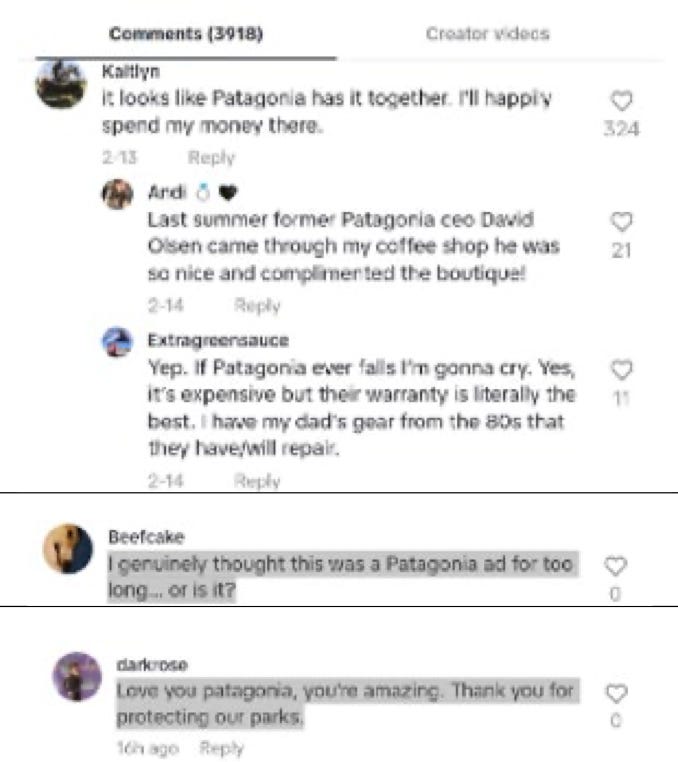
Actual consumer confusion is the gold standard of evidence in a trademark infringement case. However, the rules of evidence may prohibit the admission of these screenshots subject to proper authentication among other potential hearsay issues. If this evidence is ultimately admissible, the court may weigh this factor in favor of Patagonia.
I speculate the court may find the remaining factors – channels of trade, consumer sophistication, and likelihood of expansion – weigh at least slightly in favor of Patagonia. Regarding consumer sophistication, I’ve stumbled across several online comments that point out Pattie’s community clearly knows the difference between PATTIE GONIA and PATAGONIA. However, that’s not the standard the court will use. The standard is going to be the average outdoor apparel consumer. This includes consumers such as your retired uncle who likes to hike but doesn’t know the first thing about drag culture. Is he likely to be confused or believe there’s some sort of affiliation between these brands? That’s the type of consumer the court is going to consider when evaluating this factor.
Despite most of the factors likely landing on Patagonia’s side, the most important factor in the analysis, the similarity of the marks, could go either way. For this reason, I’m not convinced Patagonia would’ve risked the lawsuit had Pattie stuck to their core lineup of PATTIE GONIA products:14
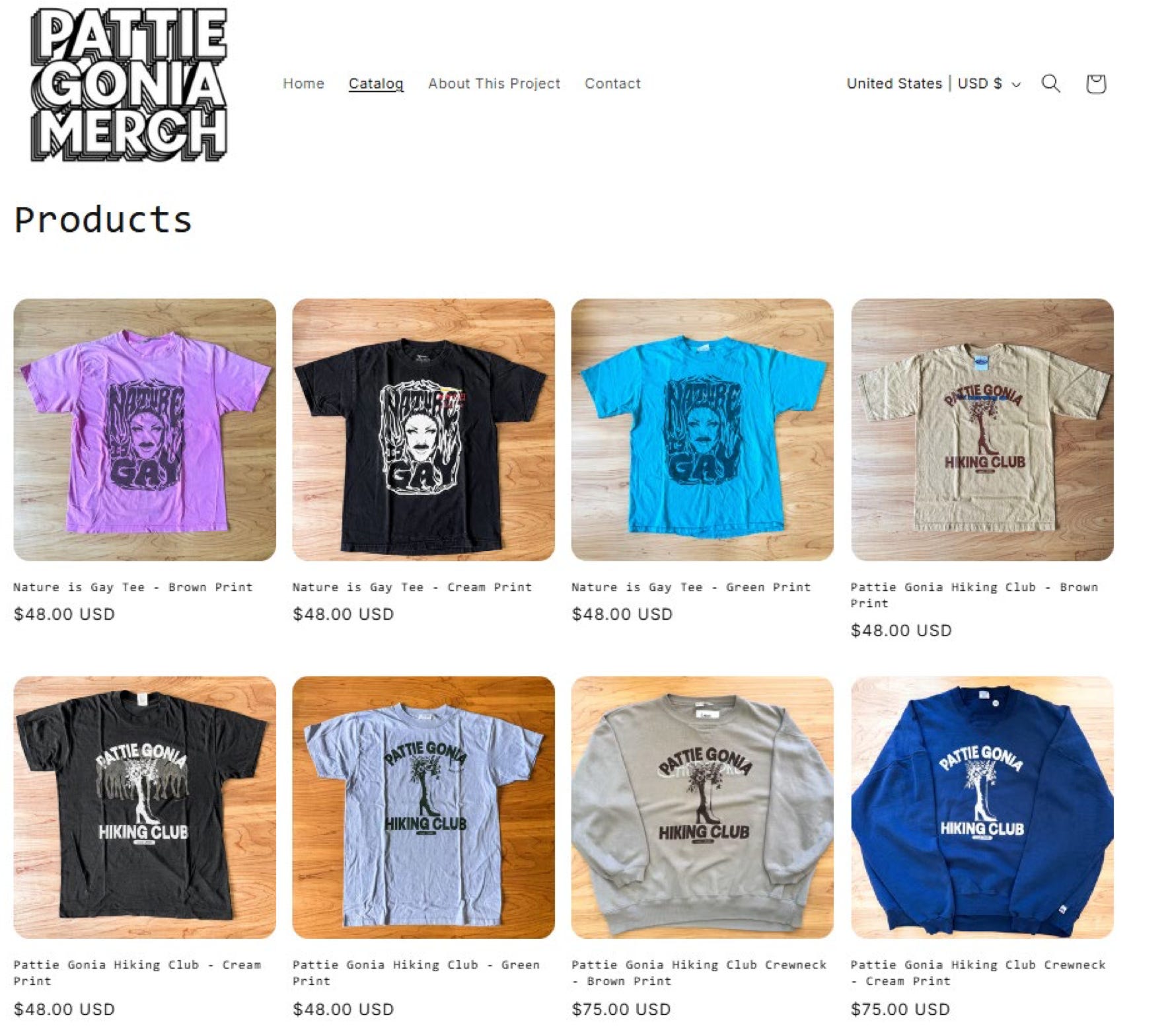
Although Patagonia still had a valid case, it would’ve been more difficult for the apparel company to argue a substantial likelihood of confusion. Despite the similarities, it’s unclear whether actual use of the PATAGONIA and PATTIE GONIA trademarks are obviously similar enough to warrant a high likelihood of confusion. Pattie uses different fonts and spellings of the trademark on almost all their merch, along with catch phrases and images aligned with their specific drag-themed branding, arguably disparate from Patagonia’s common marketing motifs.
But then, Pattie decided to fly a little too close to the sun by incorporating the P-6 logo.
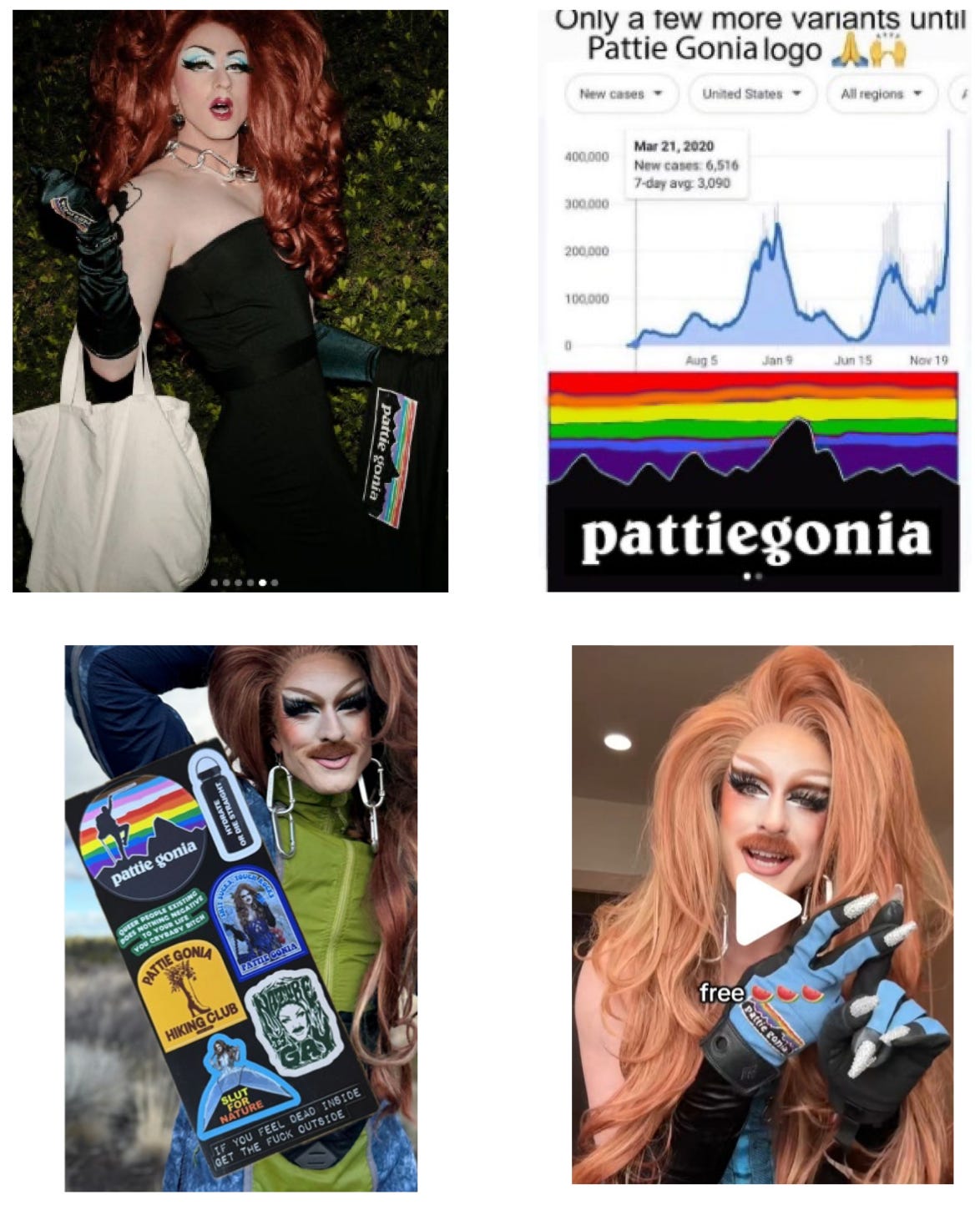
In its complaint, Patagonia included several screenshots of Pattie displaying products and images featuring knockoffs of Patagonia’s famous P-6 logo with Pattie’s branding:15
These images present a pretty significant hurdle for Pattie to overcome in their defense. In their answer and public Instagram post, Pattie claims these images are cherry-picked fan art that she did not sell directly to consumers but merely featured in PR material.
Featuring trademarks you don’t own in marketing material and advertisements is not automatically trademark infringement if it falls under nominative fair use or comparative advertising. Nominative fair use allows unaffiliated brands to feature an unowned trademark in marketing materials to identify the actual product or service being referenced. Comparative advertising allows a competitor to feature another trademark to objectively and truthfully compare their product to a competitor’s product.
Pattie’s P-6 logo spoofs probably do not fall under either of these fair use exceptions, because they aren’t real Patagonia logos. They feature the same Belwe Bold font and iconic mountain range silhouette featured in Patagonia’s famous logo, and even use a very similar color layout for the skyline, but replace the purple, blue, and red colors with the colors of the pride flag and add elements of Pattie’s branding. All in all, these aren’t real Patagonia logos, but they are near-identical versions of the company’s famous P-6 logo.
Pattie is giving away stickers featuring the spoofed P-6 logo to people who contributed to her “The $1M Dollar Backpacking Trip” Gofundme, which could be construed as promotional material associating these knockoff P-6 logos with their overall branding. Even if they are not actively selling products with this spoofed version of Patagonia’s P-6 logo, this is still very risky because it could suggest an official partnership, endorsement, or approval when one does not exist, which is exactly what Pata16gonia is alleging in its complaint. And regarding their “cherry-picking” defense, it doesn’t matter if it was one time or a hundred times; if it amounts to trademark infringement, it’s still actionable.
So how exactly does Pattie defend this as fair use? The parody defense, of course. But in the world of IP law, “parody” is not the automatic defense many people think it is.
Trademark Parody
In both their filed answer and public statements, Pattie argues their use of PATTIE GONIA and the P-6 logo is fair use as parody pursuant to Rogers v. Grimaldi, 875 F.2d 994 (2d Cir. 1989).17 The First Amendment allows for freedom of expression, which is why we have carve-outs for parody in IP law. Often in parody, it’s crucial to directly reference the source material to provide effective commentary on it. As Pattie correctly notes in their public posts, parody and satire indeed have a long history in drag culture. From name choices to costumes and song covers, drag culture and lampooning the status quo go hand in hand, and are often fully protected forms of expression under the purview of copyright law.
Most people are more familiar with the concept of parody as applied to copyright law and assume the same parameters exist in trademark law. This is not the case.
The Rogers test provides specific guidelines for allowing trademark parody. To pass the Rogers test, the mark must have some sort of artistic relevance to the underlying expressive work, and the work must not explicitly mislead consumers about its source.18 However, the Rogers test has been dramatically restricted in recent years.19 The test no longer applies if the defendant uses the trademark as a source identifier, i.e., uses the trademark as a trademark, and instead, the usual likelihood of confusion test is applied and the marks will be evaluated in the same manner as any other allegation of trademark infringement.
Regarding the PATTIE GONIA word mark, if Pattie was solely using the name “Pattie Gonia” as their stage name during live performances or as part of their social media skits, courts would likely apply the Rogers test and find that use permissible as expressive parody. However, because Pattie has filed a trademark application and is actively using the name to sell apparel and accessories, Pattie has moved beyond parody and is attempting to build a legitimate, competing brand, and it’s unlikely the courts will apply the Rogers test in this instance.
However, Pattie’s use of the P-6 logo as parody is a bit more complicated. In the images featured in Patagonia’s complaint, Pattie’s version of the P-6 logo is displayed on a pair of gloves, a handbag, a jacket, and a sticker similar to how a typical brand logo would be displayed. But because Pattie does not actively sell those items, nor have they applied for a trademark application to register their spoofed P-6 design, there is some wiggle room to claim it’s being used purely as artistic expression rather than as a trademark. However, as mentioned in the previous section, the stickers featuring the knockoff P-6 logo that they sent to fans in exchange for Gofundme contributions could be construed as promotional materials intended to establish their brand, which is generally considered legitimate use in commerce in U.S. trademark law. This may result in the court not applying the Rogers test and could further support Patagonia’s argument that Pattie’s use of the knockoff logo creates substantial risk of false association in the eyes of consumers.
It’s also worth noting that featuring the P-6 logo could serve to weaken their argument that their chosen name and branding have nothing to do with the Patagonia apparel company, as doing this creates a direct association between them.
If this litigation continues, I am interested to see how the court analyzes and decides upon Pattie’s use of the P-6 logo, as it will likely have a significant impact on when courts will apply the Rogers test in the wake of the Supreme Court’s recent VIP Prods. LLC v. Jack Daniel’s Props., Inc. decision.
Conclusion and Parting Opinions
Let’s get one thing straight: The backlash Patagonia has received because of Pattie’s recent public posts is generally unwarranted.
Back in 2022, rather than immediately taking action against Pattie, Patagonia opted to carve out an agreement with Hydroflask and Pattie Gonia, which did the bare minimum necessary to protect Patagonia’s IP while allowing Pattie to continue using the “Pattie Gonia” name and branding in connection with their environmental advocacy, LGBTQIA+ advocacy, and entertainment services. I applaud Patagonia’s initial efforts to avoid being adversarial and believe we should encourage parties to resolve potential trademark conflicts without immediately resorting to litigation.
In the apparel company’s own words featured in the complaint, “Patagonia supports advocacy and activism that promote the environment and inclusion in the outdoors, central to Pattie Gonia’s ostensible mission. For that reason, before Pattie Gonia’s activities and identity transformed into a commercial enterprise, Patagonia repeatedly communicated with Pattie Gonia and understood that the parties had reached agreement about how that advocacy work might continue in a way that would not interfere with Patagonia’s brand.”20
As evidenced by their clothing line and trademark application, Pattie is currently attempting to develop a commercial enterprise under the PATTIE GONIA word mark selling identical goods and services in direct competition with Patagonia while simultaneously featuring a strikingly similar, unauthorized version of the P-6 logo alongside their branding. While they have raised an astonishing amount of money for various civil rights and environmental protection charities, it would not excuse them of commandeering Patagonia’s trademarks and trading on the goodwill the company has taken decades upon decades to develop, if that’s what the court ultimately determines.21
Despite all this, Patagonia continues to be very gentle, even in this lawsuit. Patagonia is merely asking for Pattie to stop using confusingly similar versions of its registered trademarks in connection with her brand, stop selling infringing merchandise, and to give them $1 in damages.
One. Dollar.
And while Patagonia is also requesting legal fees, it’s not a given it will receive them, even if it wins the lawsuit in a landslide. Contrary to popular belief, it is quite unusual for courts to award legal fees to the opposing party. It’s often reserved for lopsided and frivolous claims. So, any legal expenses Pattie pays will likely be their own, and the longer they drag this out, the more expensive it will get for them.
Patagonia is not trying to “erase an activist.”
Patagonia is not launching an offensive effort against the broader drag and LGBTQIA+ communities.
Patagonia is not even asking Pattie to change their drag name.
Patagonia is simply asking Pattie to stop infringing on its trademarks. That’s it.
Wyn Wiley, the man behind the Pattie Gonia persona, could opt to continue using the “Pattie Gonia” drag name as long as the use remains an artistic expression and not a trademark. At the outset of adopting his Pattie Gonia persona, several articles were written about how the name was derived from backpacking trips to the Continental Divide Trail, a 3,100-mile trail primarily located in the western continental U.S. spanning from Southern Canada to the Mexican border, thousands of miles away from the Patagonia mountain range (and much to his chagrin, a particular uncorrected Guardian article which alleges the name was intended as a pun of the Patagonia apparel company22).23
Wiley chose not to reference the Continental Divide Trail itself when selecting the name for his alter ego. He could have used any famous mountain range from around the world, and if he wants to have more freedom to utilize his drag persona as a trademark, there are plenty of alternative options which aren’t potentially confusingly similar to a preexisting famous outdoor apparel brand. Even while writing this article, I thought of a few good ones off the top of my head: Kara Koram, after the famous Karakoram Range in Central Asia, or Sierra Nevada, after the famous Sierra Nevada de Santa Marta range in Colombia. Even Rowyn Zori, after the famous Rwenzori Mountains in Africa, would have been a fun play on Wiley’s government name.
As a practicing attorney, I don’t speak in absolutes. Anything can happen in a courtroom, and no lawsuit is a surefire win or loss. That being said, as things currently stand, I think Pattie will have a difficult time winning this case, and the recent social media posts function as a marketing opportunity and somewhat of a last-ditch extrajudicial attempt to apply social pressure on Patagonia to get them to drop the lawsuit.
Separate from my legal analysis of this ongoing trademark dispute, I take umbrage with Pattie trying to garner public sympathy by alleging the purpose of a valid trademark infringement action is meant to silence the voices of environmental activists and the LGBTQIA+ community from a company that has, based on publicly available information, remained reasonably respectful, if not outright supportive, of Pattie and their community’s activism. In my opinion, it’s misleading to accuse Patagonia of having homophobic, ulterior motives based on nothing more than remote circumstantial evidence.
The greater LGBTQIA+ community is indeed being persecuted now more than it has in recent years, and coloring this trademark infringement lawsuit as an attack on the LGBTQIA+ community is, in my opinion, self-serving behavior that takes advantage of public ignorance of IP laws and undermines the causes Pattie claims to support. My hope is this article at least helps remedy the former issue.
Pattie Gonia is right about one thing, though: The environment suffers when two major activists waste time, resources, and energy beefing in court. I sincerely hope this dispute is resolved soon so both parties can get back to focusing on what they do best without stepping on each other’s toes and, in Pattie’s case, polluting the public discourse.
Disclaimer: This article provides general educational information about trademark law and should not be construed as legal advice.
Trademark law is highly fact-specific, and outcomes depend on detailed circumstances of particular cases. This article does not create an attorney-client relationship. Anyone facing trademark issues or considering uses that may implicate trademark rights should consult with a qualified intellectual property attorney licensed in their jurisdiction.
The Patagonia v. Pattie Gonia case is ongoing litigation, and specific details about pleadings, evidence, and arguments may not be publicly available. This article discusses general trademark principles that would typically apply to such cases. The speculations, predictions, and forward-looking statements made in this article regarding the outcome of the Patagonia v. Pattie Gonia case are expressions of professional opinion only. Litigation outcomes are inherently unpredictable, and judicial decisions or jury verdicts may differ materially from this analysis. Past performance in similar cases does not guarantee future results.
The case citations and legal principles discussed are accurate as of the date of publication but may be subject to subsequent legal developments. Readers should verify current law and consult legal counsel for advice on specific situations.
Compl. at pg. 4, Patagonia, Inc. v Entrepreneur Enterprises, Inc. et al, No. 2:26-CV-0586 (C.A.C.D. Jan. 21, 2026).
Id. at ¶ 26.
Id. at ¶ 28.
Id. at ¶ 18.
Id. at ¶ 28.
Answer at pgs. 10-11, Patagonia, Inc. v Entrepreneur Enterprises, Inc. et al, No. 2:26-CV-0586 (C.A.C.D. Jan. 21, 2026)
Abercrombie & Fitch Co. v. Hunting World, 537 F.2d 4 (2nd Cir. 1976)
Answer at pg. 11, Patagonia, Inc. v Entrepreneur Enterprises, Inc. et al, No. 2:26-CV-0586 (C.A.C.D. Jan. 21, 2026)
Patagonia, Inc. v. Anheuser-Busch, LLC, No. 2:19-CV-02702-VAP-JEM (C.D. Cal. Apr. 9, 2019)
15 U.S.C. §§ 1051, 1125(c), 1127
AMF Inc. v. Sleekcraft Boats, 599 F.2d 341, 348-49 (9th Cir. 1979)
Id.
Compl. at pg. 4, Patagonia, Inc. v Entrepreneur Enterprises, Inc. et al, No. 2:26-CV-0586 (C.A.C.D. Jan. 21, 2026)
Id. at pg. 2
Id. at pg. 3
Answer at pg. 11, Patagonia, Inc. v Entrepreneur Enterprises, Inc. et al, No. 2:26-CV-0586 (C.A.C.D. Jan. 21, 2026)
Rogers v. Grimaldi, 875 F.2d 994 (2d Cir. 1989).
Jack Daniel’s Properties, Inc. v. VIP Products LLC, 599 U.S. 140 (2023)
Compl. at pg. 1, Patagonia, Inc. v Entrepreneur Enterprises, Inc. et aldba Pattie Gonia Productions, No. 2:26-CV-0586 (C.A.C.D. Jan. 21, 2026)
Id. at ¶ 36.
“The character – whose name is a pun on the California-based gear brand, though she has no sponsorship or formal connection to it – is portrayed by the Nebraska-based photographer and Eagle Scout Wyn Wiley.” Grace Perry, “Pattie Gonia: the drag queen Eagle Scout who dances on mountaintops,” The Guardian, Nov. 15, 2018, https://www.theguardian.com/us-news/2018/nov/14/pattie-gonia-drag-queen-mountaineer (accessed May 31, 2026).
“Right there on the Continental Divide Trail in Colorado, a new identity was born.” Laura Holt, “Taking on the trails with Pattie Gonia, the joyful drag-queen environmentalist who hikes in six-inch heels,” Intrepid: The Good Times, Feb. 17, 2026, https://www.intrepidtravel.com/adventures/drag-queen-pattie-gonia/ (accessed May 31, 2026)
“It was only on a backpacking trip with friends a few months later that he felt safe enough to bust them back out and then strut along the Continental Divide Trail.” Katie O’Reilly, “For This Outdoor Drag Queen, the Trail Is a Runway,” Sierra, Nov. 15, 2019, https://www.sierraclub.org/sierra/2019-6-november-december/act/for-outdoor-drag-queen-trail-runway (accessed May 31, 2026).