
“You should definitely go, for sure.” We were standing in the forward hold – where the mops and buckets, toilet brushes, and endless cans of Lysol wipes were stored – organizing its contents. My shipmate and I were making small talk as we waited for discharge from the Navy. We were a couple of duds who got screened out during boot camp for medical reasons. Suddenly, the post-military-service time horizon had moved up drastically; we had to figure out where we were headed when we got processed out. In the meantime, he and I were on forward hold duty.
On this particular day, Seaman Recruit Remy and I ended up discussing whether or not he ought to attend a university once he got home. I gave him what was then my standard answer: no doubt! Of course a university education was the best way toward the American Dream. I had a BA, and I planned on continuing my formal education as soon as my discharge was fully processed. And so should everyone else. Baked into this response was the assumption there is an inherent good in increasing the number of people who attend university. This assumption seems more ubiquitous than ever, but I’d like to offer a viewpoint which challenges it.
The U.S. populace has been told for the last century or so that a university education is the ticket to the American Dream, and has pursued it as such. Since 1940, the percentage of the population that has completed a university education has climbed steadily [2, Figure 2]. As a culture we have indexed heavily toward encouraging as many to attend university as possible. I’d like to draw an analogy between this viewpoint and a concept that may not seem related at first: Braess’s Paradox.
Flow
A flow network is a collection of nodes and edges, where edges pass along some sort of substance or widgets between nodes. You might think of a watering hose as a network. The nodes in this case would be the spigot and your vegetable garden, and the edge would be the hose itself. The widget being passed between nodes here is water; it flows in one direction from spigot to garden. Here’s a boiled down image of your garden hose network:

Crucially, your hose has a limited capacity. The edge denoting the hose is labelled with a 5 to denote your hose has a capacity of, say, 5 gallons per minute. If your neighbor’s house were to catch fire, your garden hose wouldn’t be able to flow enough water to make much of a difference.
Now let’s consider a different sort of network: a road. The nodes are intersections or other important locations, and the edges are the roads themselves, passing cars between nodes. Consider the the road network denoted by this diagram:
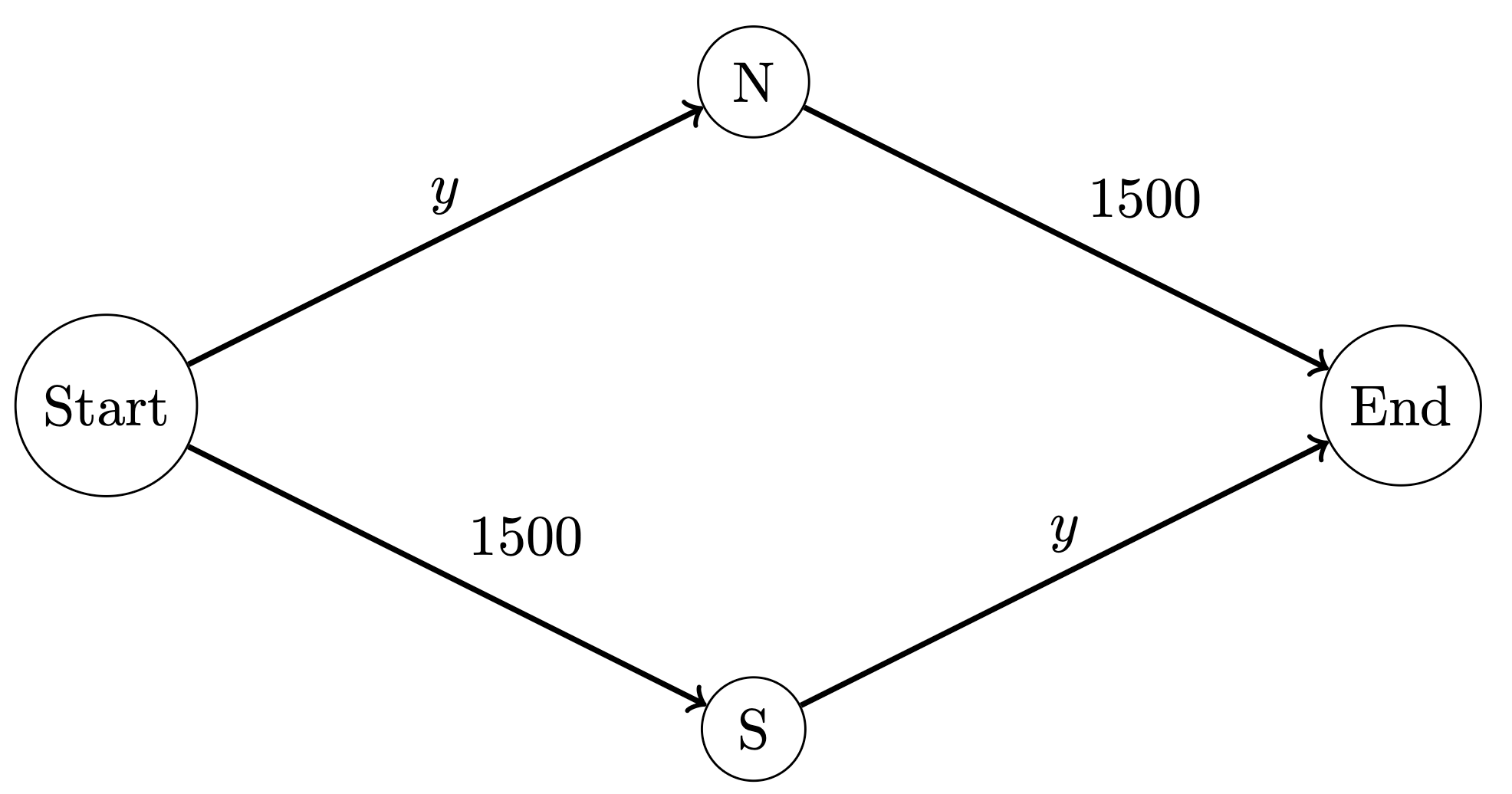
The roads in this diagram have varying capacities, which means travel times vary. We say the roads (Start → S) and (N → End) have essentially infinite capacity; no matter how many travelers drive on these roads, there is always a travel time of 1500 sec. (25 min.). The roads (Start → N) and (S → End), however, have a limited capacity. These roads have a travel time that changes with the number (y) of travelers on them. That means if there is only one driver on the route (Start → N), their travel time would be 1 sec.1; however, if there are 1,000 drivers on the route (Start → N), their travel time would be 1000 sec. (about 16.6 min.). In other words, traffic becomes a major factor on roads with limited capacity.
In this road network, what is the best way for a collection of 1,000 drivers to travel from Start to End? The optimal solution is exactly what you might guess: 500 of the drivers take the “Northern” route (Start → N → End) and the other 500 take the “Southern” route (Start → S → End). Each route’s travel time is 500 + 1,500 = 2,000 sec. (about 33.3 min.).
Now imagine you’re a city planner tasked with decreasing travel times (Start → End). What if we now added a road, say (N → S), with a very short travel time of 250 sec.? That would give us this network:
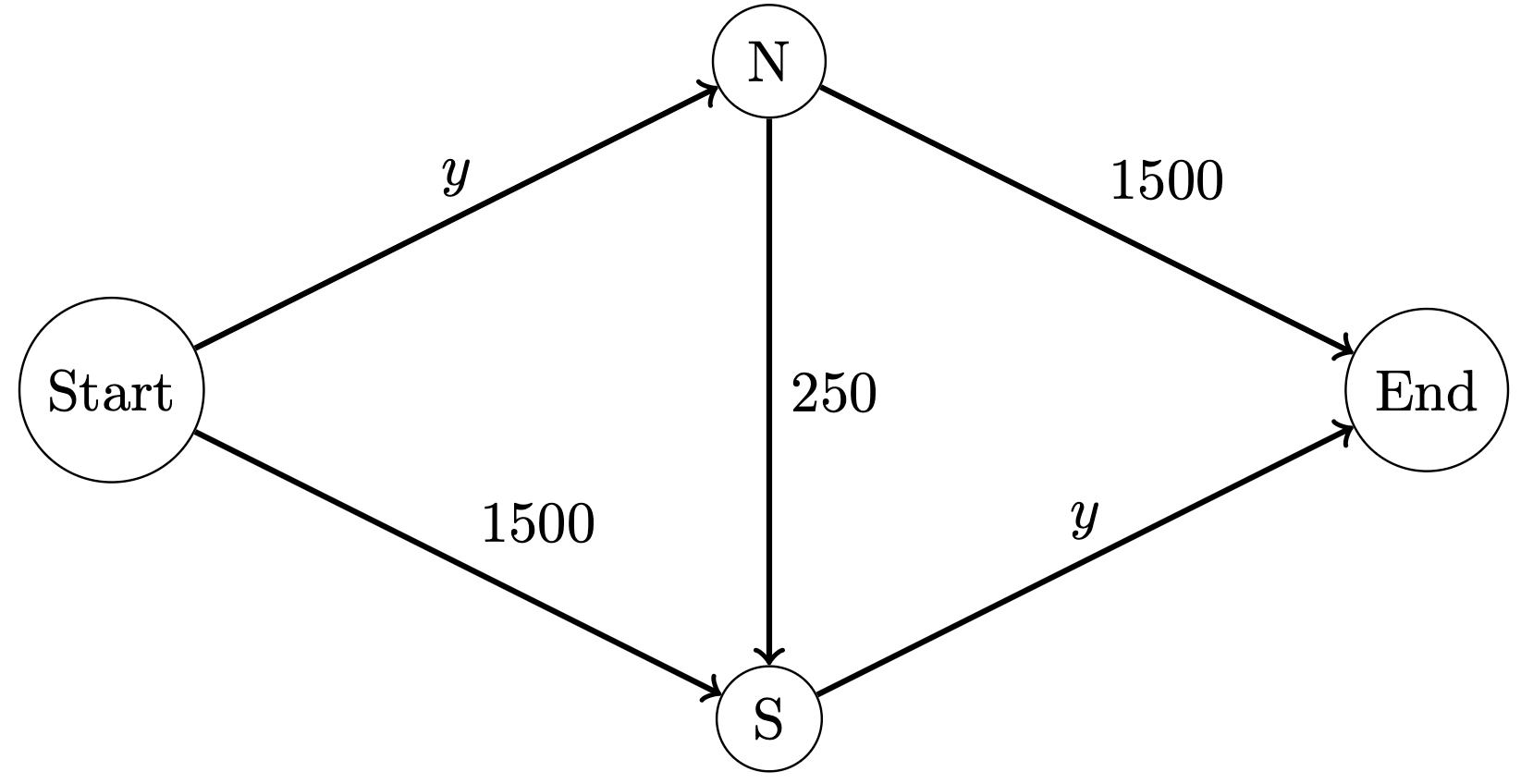
It seems adding roads should always improve the situation. But what if one previously Northern traveller decides to take the route (Start → N → S → End)? Their travel time would be 500 + 250 + 501 = 1,251 sec. (about 21min.), a huge improvement! This single traveler has found a faster route and should be proud of this clever re-routing. Soon enough, more and more travelers will discover this time-saving route and choose to take it themselves. Eventually, traffic building up on (Start → N) and (S → End) will make it so the previously optimal Northern and Southern routes take more time than the new (Start to N to S to End) route, meaning everyone will choose this new middle route. But since every driver is now taking it, the travel time on this new route is now 1,000 + 250 + 1,000 = 2,250 sec. (about 37.5 min.) When we incorporate the incentives of the drivers, this new road has somehow increased the best case travel time!
This happens because there is no cooperation among drivers. If everyone got together and decided as a group to ignore the new road, they could all save on travel time. Individual pressures force collective suboptimality. This phenomenon is called Braess’s Paradox, and Steve Mould made a great video on the topic using springs to illustrate this mind bender.
College and Flow
I think we’re stuck in an instance of Braess’s Paradox when it comes to university education. We can roughly think of the end node as “attaining the American Dream,” the Northern and Southern routes as what may have been a typical life path until several decades ago, and the optimal route as a college education. College education was, for some time, a way to blast off into a middle-class wealth level. And we should expect most people seeing such an apparent optimum to take it, or encourage their kids to take it, or encourage their friends to take it, like I did with Remy and so many others.
But we need to face the reality that our current system is congested. Recent college graduates aged 22-27 have a higher unemployment rate than the national average [1]; the dollars-and-cents utility of higher education is evaporating. We’re slowing everyone down by encouraging people to take what used to be an optimal route.
The thing is, though, I don’t know what the answer is. I can’t offer a good heuristic for who should or shouldn’t pursue higher education. And I sure as hell don’t know how to convince a whole society looking for the optimum that we’d all be better off if fewer people tried it.
If we’re going to change, we have to start somewhere. Maybe we start by giving the young adults who hated school and are going to college to appease a parent permission to stop. Why don’t we stop viewing a “dropout” as someone who couldn’t hang? Let’s (and I mean us, college educated snobs!) check our own ego over completing a degree that, statistically, isn’t doing as much good as it should be.
Let’s start showing young adults the rest of the network.
References
[1] Federal Reserve Bank of New York. The Labor Market for Recent College Graduates. Electronic. 2026. url: https://www.newyorkfed.org/ research/college-labor-market#--:explore:unemployment.
[2] Camille L. Ryan and Kurt Bauman. Educational Attainment in the United States: 2015. Electronic. 2016.
Unrealistic, I know! But this simplified example is sufficient to get the point across.