

The three-body problem, made famous by Cixin Liu’s novel of the same name, refers to the famous physics phenomenon involving mathematical chaos from the movement of three bodies, usually planetary, around a gravitational field. The two-body problem is somewhat similar… involving two academics revolving around a chaotic and specific job market. For two of JUNC’s founders, navigating the two-body problem is beginning to feel impossible.
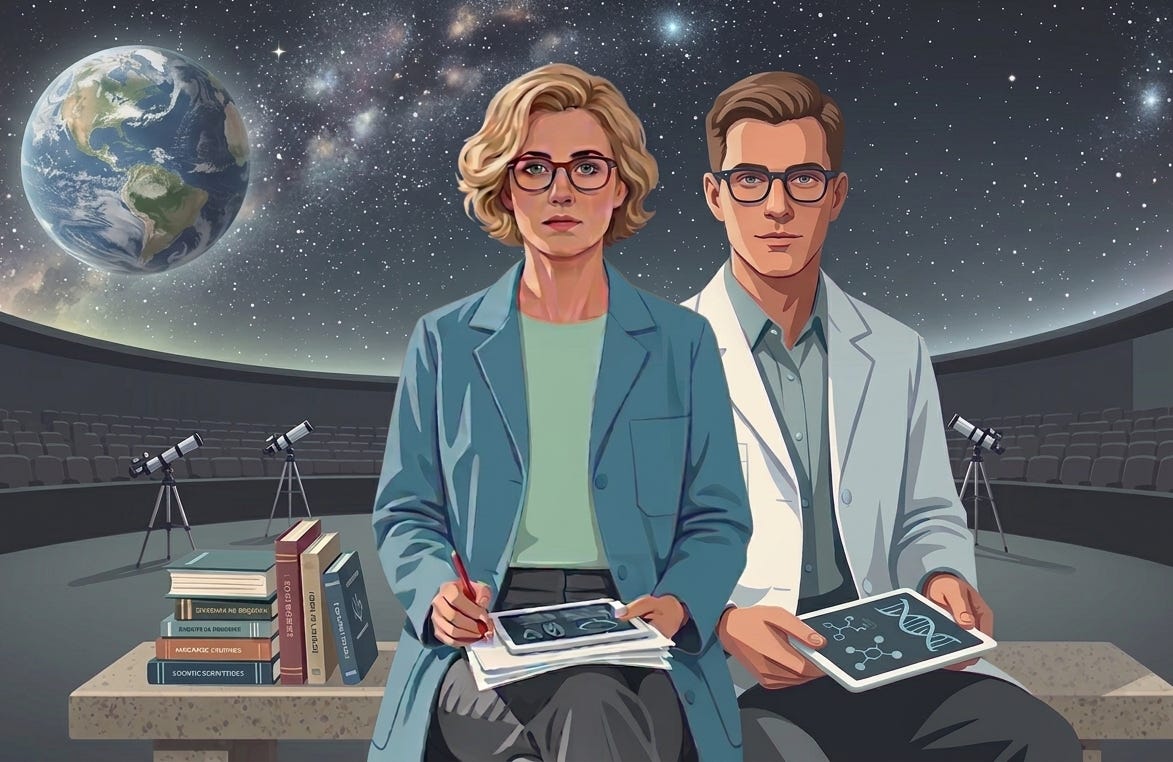
It all started back in September 2015. Noah moved from the back of the Bio101 lecture hall to a seat nearer me (Becca). Later, he stated he had made the move because he wasn’t paying attention and “Becca looked like a nerd and had a GPS watch on.” To be fair, I am a nerd, and 2015 fitness watches were about the size of a satellite dish.
Push came to shove, and after 3 years and 10+ lab partnerships, we could no longer ignore our romantic chemistry and began dating. Over the past 11 years, we have never stopped being each other’s biggest supporters inside (and outside) the research labs. We both attended RPI for our doctoral studies, joking that I minored in biomedical engineering and Noah in chemical biology. Eventually, postdoctoral fellowships landed us in the same research group, working on adjacent projects, co-authoring publications, sharing resources, and navigating the worst job market since 2008.
In a typical job market, navigating the two-body problem is frustrating but doable: Universities and private companies can extend partner-placement options during the negotiation phase, big biotechnology hubs like Boston and San Francisco have deep networks for referrals nearby, and occasionally partner duos become co-PIs in large research facilities. Unfortunately, 2026 is providing us with anything but typical in terms of the job market.
Since Trump was re-elected in the fall of 2024, over 95k federal workers have left scientific agencies, including 10k doctoral level researchers1. According to Science, federal agencies lost 11x more STEM PhDs compared to those gained in 20252. These losses have been even bigger in private industries, where Biospace tracked nearly 43k layoffs in the biopharma sector in 2025 – a nearly 50% increase compared to the prior year3. Things aren’t any better in the academic sector, where over 10k positions have been cut in the same period and upwards of 40% of private colleges are at risk of closing due to financial deficits4 – check out my previous JUNC article where I dig deeper into this statistic. These numbers total to a staggering 148k STEM-focused layoffs in the U.S. since fall 2024, albeit not all at the PhD level.

What does this all look like for JUNC’s founders? To say the least, it’s frustrating. To say the most, combined, we have been denied from approximately 2,000 jobs.
Statistically, this doesn’t even make sense.
Stanford actually just proved that it doesn’t make sense.
Bommasani et al.5 released a staggering report on the use of AI tools in hiring. They found over 90% of U.S. employers are relying on hiring algorithms to screen or rank applicants, and many are using the same third-party vendors. The two main findings from the paper are (1) the algorithms are racist in their rankings and (2) individuals receive homogeneous outcomes. Specifically, they found 4% of all applicants who apply to 10 positions are rejected from all, which is a rate higher than chance. They state applicants impacted by homogenous rejections need to apply far and wide to escape the AI rankings keeping their applications from human eyes.
How many is enough? Of the 2,000 applications we’ve submitted, we have about a 1% success rate in securing interviews and a 0% success rate in receiving offers.
Bommasani et al.5 also reported some vendors may only allow one application ranking per year5. It is unclear whether these rankings exist within the AI tool (i.e., one ranking allowed per year regardless of company, job title, resume/cover letter changes, or referral statuses), or within each company, or if they exist at all. AI vendors are not releasing this information to the public, and companies utilizing vendors are not being transparent on which tools they are using.
What does this all mean for Noah and me? We’re not sure anymore. It’s clear the job market has been swayed by politics, finances, AI tools, and uncertainty for the past two years. We plan to continue to pursue employment opportunities that align with our values – jointly applying where we can within academia, industry, and federal. We are continuing to work together on our postdoctoral projects, co-applying to grants and submitting peer-reviewed manuscripts. Noah is leading JUNC, building a collective of creative intellects, and looking to expand into new mediums. (Should we start a podcast?)
Ultimately, we will push through this bubble as the team that we are. I hope our two-body problem ends similarly to the three-body physics equation: through the collision of two scientists and one convenient geographical workplace. In our case, the collision of these three bodies is ideal.
